
Water Heater Repair and Replacement
Tank and tankless heaters in Cuyahoga Falls, gas or electric: repaired when a part has failed, replaced when the tank has.
Water heater replacement is one of the jobs we do most. Not every heater that acts up needs replacing, though. A heater that will not stay lit, runs out of hot water early or makes the water too hot often has a failed part. A tank that leaks from the bottom or turns the water rusty is a different story.
Repair or Replace?
Repair makes sense when the tank itself is sound and a part has failed: a thermocouple or flame sensor on a gas heater, a gas control valve, a heating element or thermostat on an electric one, or a relief valve that drips. These are common fixes and usually take a single visit.
Replacement makes sense when the tank is leaking, when the water comes out rust-colored from the hot side only, or when the heater is past about ten years old and the repair would be a major part. A leak from the tank body cannot be patched.
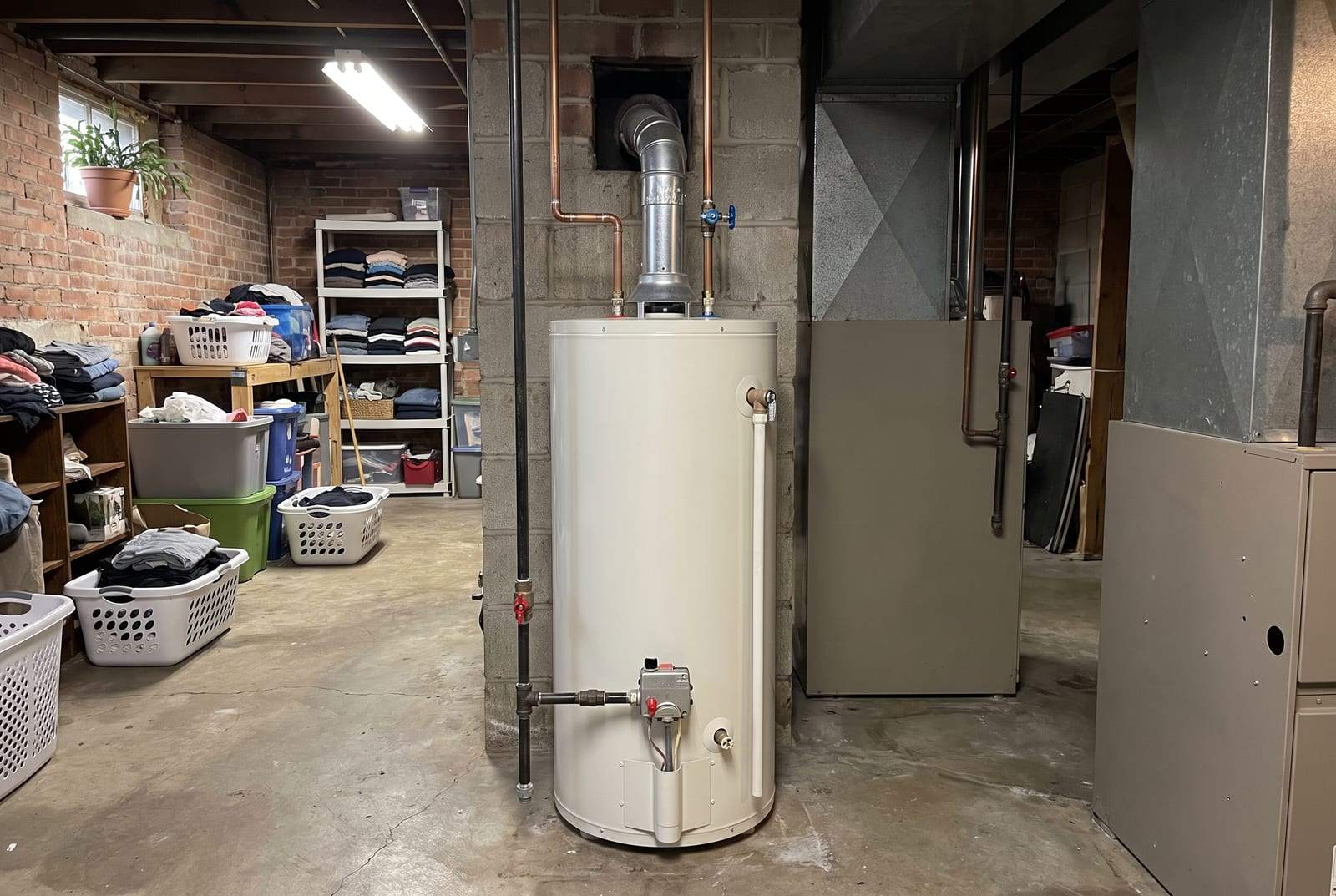
Whichever it is, we check the water temperature at a faucet, the venting and the temperature and pressure relief valve before we leave. On a gas heater that means watching the draft at the vent with the burner running, so exhaust goes up the flue and not into the basement.
Water Heater Sizing Guide
Choose your household and press the button for a size range to talk over with us.
Pick your household above, then press the button.
Tank vs Tankless
| Factor | Tank | Tankless |
|---|---|---|
| Space | A cylinder about two feet across and five feet tall on the floor | A wall-mounted box about the size of a carry-on suitcase |
| Fuel | Natural gas, propane or electric | Natural gas, propane or electric; gas models often need a larger gas line |
| Lifespan | Often 8 to 12 years, less where sediment builds up | Often 15 to 20 years with yearly descaling |
| Flow | A stored supply, then a wait while the tank reheats | Hot water without running out, but only so many fixtures at once |
| Venting | Gas tanks usually vent up the chimney through a draft hood | Sealed vent through an outside wall; the chimney is rarely reused |
| Upkeep | Drain some water yearly to clear sediment; check the anode rod | Flush the heat exchanger and clean the inlet screen yearly |
Tankless heaters make the most sense in homes that run out of hot water often or where floor space matters. In many older Cuyahoga Falls basements, a tank is still the simpler swap, since the gas line, venting and drain are already in place for it.
Signs Your Water Heater Is Failing
- Rust-colored water from the hot taps only.
- Rumbling, popping or knocking from the tank as it heats.
- Water pooling around the base, or rust and dampness at the bottom seam.
- No hot water, or hot water that runs out much sooner than it used to.
- A pilot light that will not stay lit, or a burner flame that is yellow instead of blue.
- A relief valve that drips or a discharge pipe that is wet at the end.
A leak at the base usually gets worse quickly. Shut off the cold water valve at the top of the heater and turn the gas control to pilot or switch off the breaker, then call.
Water Heater Questions
How long does a water heater last?
A tank heater commonly lasts 8 to 12 years. Hard water, a heater that has never been flushed, and a worn-out anode rod shorten that. The manufacturing date is printed in the serial number on the label; if your tank is past ten years and starting to show symptoms, replacement is usually the better spend.
Should I flush my water heater?
Draining a few gallons from the valve at the bottom once a year carries out loose sediment before it hardens. On a tank that has never been flushed in many years, the valve can clog or start to drip once opened, so it is worth having us do the first one.
Why does my pilot light keep going out?
The most common cause is a worn thermocouple or flame sensor that no longer tells the gas control the pilot is lit. A dirty pilot tube, a draft near the burner or a failing gas control can do it too. If you smell gas, do not relight anything: leave the house and call the gas utility first.
What is the rumbling or popping sound in the tank?
That is sediment. Minerals settle on the bottom of the tank, water trapped under them boils, and the bubbles pop through. The heater works harder and the bottom of the tank runs hotter. Flushing can help early on; loud, constant rumbling on an older tank is one of the signs it is wearing out.
No hot water, or water around the base of the tank? Call us and describe what you see.